When AI Investment Becomes a Macro Variable: Reading the IMF's October 2026 Outlook
The IMF credits AI investment with holding 2026 global growth above 3%, while flagging the same boom as a concentration risk. An evidence-based reading with two charts.
Key points
- The IMF projects global growth of 3.1% in 2026 and 3.4% in 2027, and attributes much of the resilience to AI-related investment that offset a war-driven energy shock (Lawder, 2026).
- Trade in AI-related goods grew 29% cumulatively over 2023–2025, against 8.3% for total trade; without AI goods, total trade growth would have been 4.6% (Ajanapanya, 2026).
- Growth is concentrating: 32 economies now account for 95% of global growth, down from 54 in April (Lawder, 2026).
- The same concentration is the main downside risk. An earlier IMF scenario of a moderate AI-valuation correction lowered global growth by 0.4% relative to baseline (IMF, 2026a).
1. Introduction
Each IMF World Economic Outlook (WEO) is read for its headline number. The October 2026 edition, Resilience under Strain, Urgent Choices, is more interesting for what the number is made of. The world economy absorbed an energy shock from the war in the Middle East, with oil above $100 a barrel (Lawder, 2026), and still grew at a pace the Fund describes as resilient.
Research question. How much of this resilience can be attributed to AI-related investment, and what does that imply for the risks to the outlook? This post separates facts reported by the IMF and the press, my interpretation of the mechanisms, and hypotheses worth testing.
2. Facts: what the October 2026 outlook reports
The IMF projects global growth of 3.1% in 2026, up 0.1 percentage points from July, and 3.4% in 2027. For comparison, global growth in 2025 was 3.5% (Lawder, 2026; Xinhua, 2026), so the IMF expects a slowdown in 2026 and a partial recovery in 2027. The path of the 2026 forecast during the year shows how the picture changed (Figure 1).
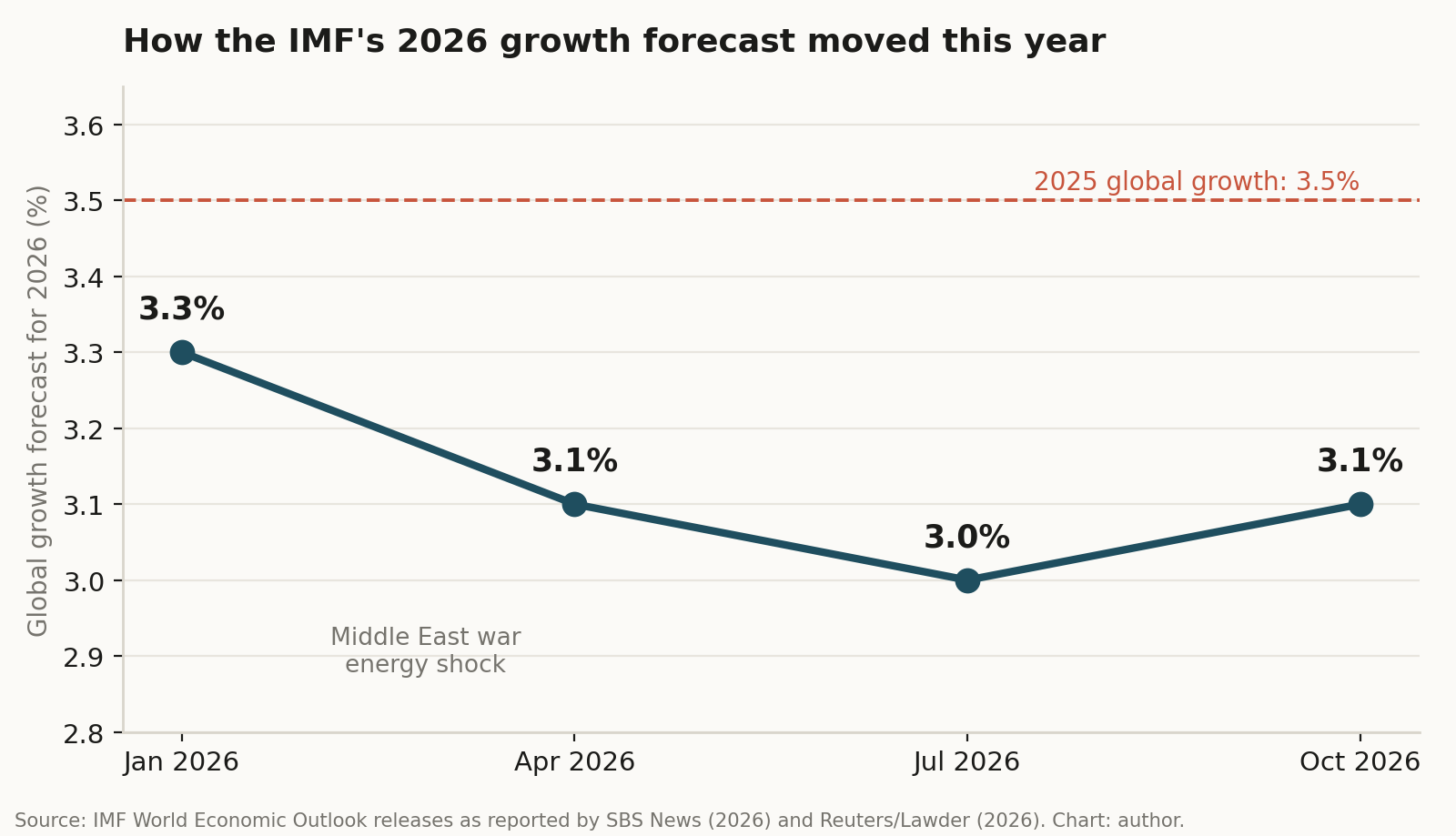 Figure 1. The IMF’s forecast for 2026 global growth by release. Data as reported by SBS News (2026) and Lawder (2026).
The Fund credits AI-related demand for part of the October upgrade, especially in economies that supply AI hardware, such as South Korea, Malaysia, Mexico and Thailand (Lawder, 2026). The trade data make the point sharply (Figure 2): AI-related goods grew much faster than other trade, and without them total trade growth over 2023–2025 would have been 4.6% rather than 8.3% (Ajanapanya, 2026).
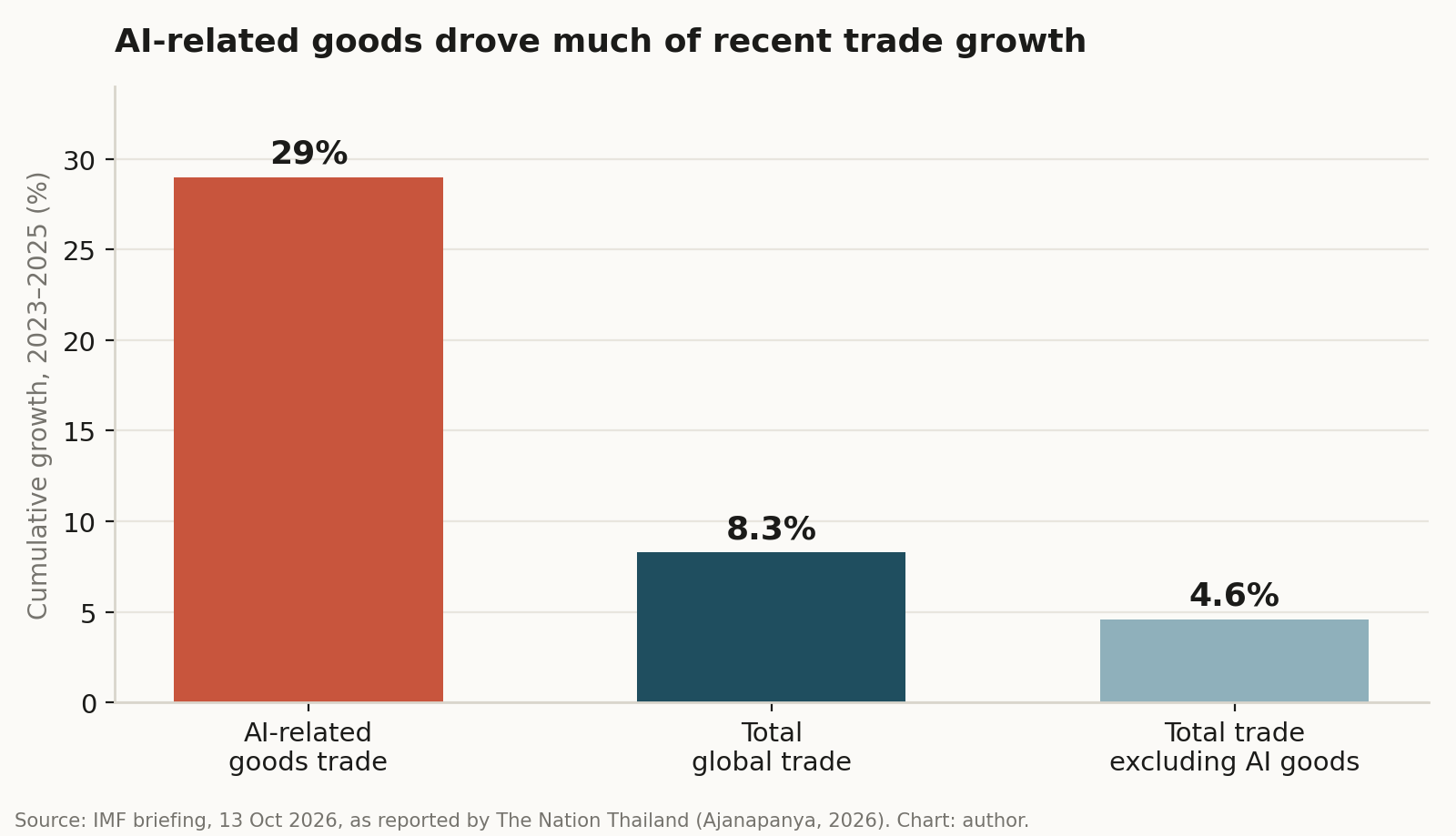 Figure 2. Cumulative growth in trade, 2023–2025. Source: IMF briefing as reported by Ajanapanya (2026).
Two further facts matter for the risk assessment. First, adjustments in energy markets, such as rerouted supplies and inventory drawdowns, kept 2026 growth at 3.1% rather than about 2.5%, but the IMF’s Economic Counsellor warned that some of these margins are near their limits (Ajanapanya, 2026). Second, the IMF’s January 2026 analysis noted that US information-technology investment, as a share of output, had reached its highest level since 2001 (IMF, 2026a).
3. Interpretation: two shocks, one inflation problem
The IMF describes the war as a supply shock and the AI boom as a demand shock. They pull activity in opposite directions, but both push inflation up (Ajanapanya, 2026). My reading is that this explains why the 2026 forecast fell after the war began, recovered by October, and still comes with a higher inflation forecast of 4.7% for 2026 (Ajanapanya, 2026).
AI investment supports growth before productivity gains are measured. It raises demand through capital formation and the trade in chips and equipment. Its durability therefore depends on expected returns, which the Fund links to stock valuations (Ajanapanya, 2026). If those expectations are revised, investment can reverse faster than the productivity benefits arrive.
4. Concentration risk
The growth upgrade is narrow. Only 32 economies generate 95% of global growth, compared with 54 in April, and 47% of economies have had their forecasts downgraded (Lawder, 2026; Xinhua, 2026). The IMF’s own summary points to a growth model that leans on supply chains concentrated in a few countries, sectors and firms, so a market correction or an AI-related cyber threat could weigh on growth and financial stability (Ajanapanya, 2026).
For scale, the Fund’s earlier scenario of a moderate correction in AI valuations lowered global growth by 0.4% relative to baseline (IMF, 2026a). By my arithmetic, that is four times the 0.1-point upgrade made between July and October. This comparison is illustrative: the October 2026 report contains its own scenarios, which I have not reproduced here.
5. Counterarguments and limitations
- Upside case. The IMF also notes that longer-lasting AI investment with real productivity gains could lift growth (Ajanapanya, 2026). The risk is two-sided.
- Attribution. Saying AI “offset” the energy shock is a model-based judgment, not an observed counterfactual.
- Data. I used the IMF launch page and press coverage of the IMF briefing, not the full report tables. The coverage I used does not state whether the trade figures are in value or volume terms. Readers should check the figures against the published WEO before citing them.
- Analogies. Comparisons with the dot-com period are informative but imperfect; the composition of today’s investors and firms differs.
6. Hypotheses worth testing
- H1: Economies whose growth depends more on AI-linked trade show higher output volatility around changes in AI-sector valuations.
- H2: AI-hardware exporters grow faster than standard trade models predict, controlling for global demand.
- H3: Valuation-driven wealth effects, rather than cash flows, explain most of the sensitivity of AI investment to financial conditions.
7. Conclusion
The October 2026 outlook treats AI investment as a macroeconomic variable: a source of demand that helped the world economy absorb an energy shock, and a concentrated exposure that could reverse. In the IMF’s words, as reported, that resilience is reaching its limits (Ajanapanya, 2026). Whether the boom becomes durable productivity growth or a correction is the central empirical question for the next year.
References
Ajanapanya, N. (2026, October 13). IMF warns global resilience ‘reaching its limits’ as risks tilt downward. The Nation Thailand. https://www.nationthailand.com/business/economy/40072200
International Monetary Fund. (2026a, January 19). Global economy shakes off tariff shock amid tech-driven boom [Blog post]. https://www.imf.org/en/blogs/articles/2026/01/19/global-economy-shakes-off-tariff-shock-amid-tech-driven-boom
International Monetary Fund. (2026b, October 13). World Economic Outlook, October 2026: Resilience under strain, urgent choices. https://www.imf.org/en/publications/weo/issues/2026/10/13/world-economic-outlook-october-2026
Lawder, D. (2026, October 13). AI investment props up global growth, but war and debt threaten outlook, IMF says. Reuters. https://www.al-monitor.com/originals/2026/10/ai-investment-props-global-growth-war-and-debt-threaten-outlook-imf-says
SBS News. (2026, October 13). IMF raises 2026 global growth forecast to 3.1%, citing AI investment boost. https://news.sbs.co.kr/english/article.do?news_id=N1008794945
Xinhua. (2026, October 13). IMF edges up 2026 global growth forecast to 3.1 pct as Mideast conflict, AI boom split world economy. https://english.news.cn/20261013/8ed2312c42d640b79237e2756ed1b86c/c.html