The First Rung: What the Data Says About AI and Entry-Level Jobs
Headlines say AI is taking entry-level jobs. I read the main 2025 and 2026 studies to see what survives scrutiny, and what it means for someone about to start a career.
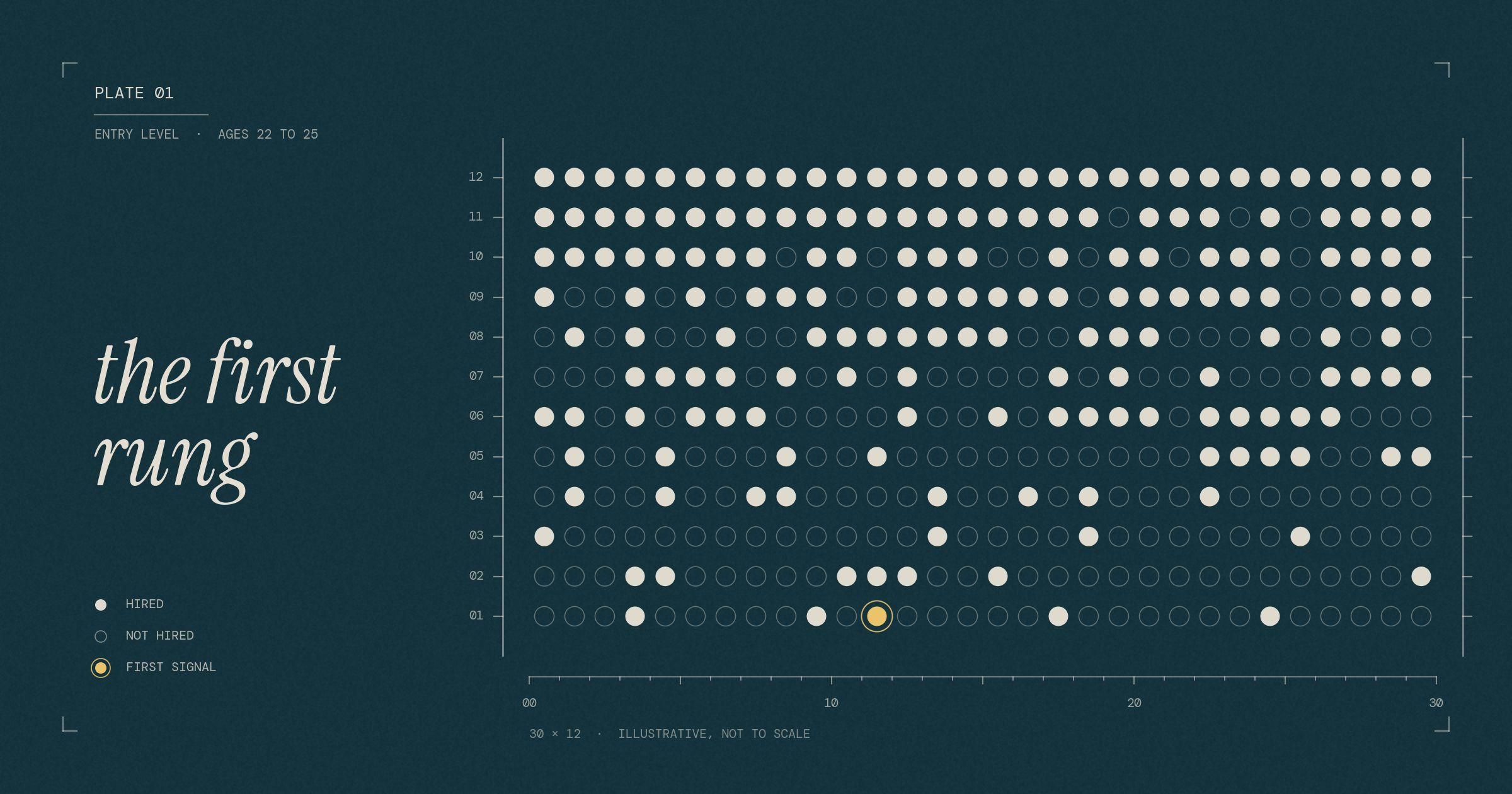
Key points
- Payroll data from the US shows that employment of 22 to 25-year-olds in AI-exposed occupations is now 19% below where it would be if it had kept pace with less-exposed peers, while experienced workers show no comparable gap (Brynjolfsson et al., 2026).
- The gap works through fewer hires, not more layoffs. The same authors find no evidence of economy-wide displacement.
- Whether AI causes the gap is contested. Remote work, interest rates and pre-existing trends compete as explanations, and national administrative data from Finland and Norway do not show a clear effect.
- My reading: something real is happening at the hiring margin in some exposed occupations, the size attributable to AI is unknown, and the cost of a thinner first rung may arrive years later.
1. Why I picked this question
A BSI study reported this week says half of large businesses have already cut junior roles, against 30% of small and medium-sized ones, and that company annual reports mention automation almost seven times more often than training or upskilling (Qazinform, 2026). Statements about what firms say they do are not employment data, so I went looking for the data.
I should say where I stand. I am an economics graduate preparing for graduate study, which puts me close to the age group in question. That is a reason to be careful about which answer I would like to be true.
2. What I read and how I weighed it
I started with the study behind most of the headlines, the Stanford “canaries” paper, and then read the studies that replicate it, extend it or disagree with it. They use four kinds of data: payroll records, government administrative records, online job postings and surveys. I gave the most weight to payroll and administrative data, because job postings measure what firms advertise and surveys measure what people report.
I also separated two ideas that get mixed up. Exposure means an occupation contains tasks AI could do. Adoption means a specific firm has started using generative AI. A study of exposure can pick up anything that correlates with those occupations, such as remote work. A study of adoption can pick up the fact that adopting firms differ from the rest.
To find studies I would have missed, I used the literature review by Imas and Schaal (2026). I opened the Stanford page directly. For most other papers I am relying on the authors’ abstracts and on that review, and almost all of them are working papers that have not been through peer review.
3. The case that something is happening
The Stanford study uses payroll data from ADP covering millions of US workers through June 2026. Its headline is that employment of workers aged 22 to 25 in AI-exposed occupations is 19% below the path it would have followed had it matched less-exposed peers. The divergence has widened since the authors first reported it in August 2025, it runs through reduced hiring rather than separations, and it is concentrated in occupations where AI mostly substitutes for human tasks. Where AI mostly complements workers, employment is flat or rising (Brynjolfsson et al., 2026).
Figure 1. The reported estimates differ in data and method; they should not be read as a consistent time series.
Other data point the same way. A Census Bureau study finds that in the most AI-exposed fifth of industries, hires of 22 to 24-year-olds dropped by about 9% right after ChatGPT’s release (Tucker, 2026). Another Census study follows 6.7 million bachelor’s graduates and finds that graduates of the most exposed tenth of majors, mostly computer science, were about 5 percentage points less likely to be employed right after graduation, with initial earnings about 13% lower (Orr et al., 2026). The Dallas Fed’s reading of the Stanford result adds a detail: the drop comes mainly from fewer people moving from outside the workforce into jobs, not from layoffs (Federal Reserve Bank of Dallas, 2026).
Adoption studies agree in direction. Firms that adopt generative AI employ about 8 to 10% fewer junior workers after two years than comparable non-adopters, while senior employment barely moves (Hosseini Maasoum & Lichtinger, 2026). A 41-country study finds that adoption lowers the junior share of employment by 1.9 percentage points, but mostly because adopters add senior staff, not because they cut juniors (Chandar & Klein Teeselink, 2026).
4. The case for caution
The Stanford authors call their own findings early, descriptive indicators rather than causal estimates, and they note that the patterns weaken once education is controlled for and that some divergent trends predate generative AI (Brynjolfsson et al., 2026). Imas and Schaal (2026) report that the gap roughly halves with controls for occupational education levels.
The strongest rival explanation is remote work, because it is highly correlated with AI exposure: both describe white-collar, computer-heavy jobs. One study finds that remote-work exposure explains the timing of falling junior hiring about as well as AI exposure does (Lambert & Schindler, 2026). Others push back. The adoption study above finds the junior decline just as large in jobs that cannot be done remotely, and the Stanford authors re-ran the remote-work specification on payroll data and got the opposite result (Imas & Schaal, 2026). Interest rates and post-pandemic overhiring are the other usual suspects.
Administrative data from the Nordic countries are the least favorable to the headline. A Finnish study finds no effect of AI exposure on youth wages or employment (Kauhanen & Rouvinen, 2026). A Norwegian study finds no significant negative effect on junior employment and shows that junior employment in exposed occupations started falling before ChatGPT (Facius & Iacono, 2026). A Danish study linking surveys to administrative records finds null effects on earnings and hours and rules out effects larger than 2% two years after ChatGPT’s launch (Humlum & Vestergaard, 2026).
On the economy as a whole, the effect is small so far. The Dallas Fed calculates that even if the entire decline in young, AI-exposed employment turned into unemployment, it would add only 0.1 percentage points to the aggregate unemployment rate (Federal Reserve Bank of Dallas, 2026). The summer of 2026 is consistent with that: unemployment among 22 to 25-year-old college graduates averaged 7.3%, inside the 6.3% to 7.8% range of the previous four summers (Fairlie & Wu, 2026, as summarized by Imas & Schaal, 2026).
Figure 2. The 7.3% estimate falls within the 6.3%–7.8% range of the previous four summers.
Two details matter here. A broader measure that counts graduates who want a job but are not searching reached 10.4%, the highest of the five summers, though not significantly different. And the sample is small enough that it cannot rule out increases of 2 to 3 percentage points. A sharp drop concentrated in a few exposed majors, as in the Census graduate study, would barely move this average.
| Study | Data | What it finds | Main caveat |
|---|---|---|---|
| Brynjolfsson et al. (2026) | US payroll (ADP) | Employment of young workers in exposed jobs 19% below peers | Descriptive, shrinks with education controls |
| Tucker (2026) | US Census, industries | Hires of 22 to 24-year-olds down about 9% after ChatGPT | Young workers were already slipping after the pandemic |
| Orr et al. (2026) | US Census, graduates by major | 5 points lower early employment in exposed majors | Self-employment and graduate school may explain up to half |
| Hosseini Maasoum & Lichtinger (2026) | US résumés and postings | Juniors down 8 to 10% at adopting firms | Adopters may differ from non-adopters |
| Chandar & Klein Teeselink (2026) | LinkedIn, 41 countries | Junior share down 1.9 points at adopters | Mostly more seniors, not fewer juniors |
| Lambert & Schindler (2026) | Postings, 4 countries | Remote work explains the timing as well as AI | Contradicted by a payroll re-run |
| Kauhanen & Rouvinen (2026) | Finnish admin data | No effect on youth employment or wages | Exposure scores cover 79% of workers |
| Facius & Iacono (2026) | Norwegian admin data | No significant negative effect | Decline began before ChatGPT |
| Humlum & Vestergaard (2026) | Danish surveys and records | Null effects on earnings and hours | Covers 11 occupations |
5. Why a small number can still matter
Even if the aggregate effect stays small, the first rung is where people learn. Ide (2025) builds a model in which automating entry-level tasks raises productivity today but weakens the skills of later cohorts, and a back-of-the-envelope version of it lowers long-run US GDP growth by 0.05 to 0.35 percentage points (as summarized by Imas & Schaal, 2026). Garicano and Rayo (2025) model apprenticeship directly: whether it survives depends on the value of an AI-augmented graduate compared with what AI can do on its own. Both are theoretical models, and their numbers are illustrations, not forecasts. They share a mechanism, though. Firms that stop hiring juniors are drawing down the stock of seniors they will need later.
6. My view
This section is my own judgment.
First, the debate is about hiring, not firing, and that makes it easy to miss. Layoff statistics have shown very little. Nobody files a claim for a job they never got, so a thinner first rung does not show up where we usually look.
Second, I think attribution is the open question and I would not put the 19% on AI alone. The authors’ own caveats, the remote-work dispute and the Nordic nulls all push the number down. I still find it hard to dismiss an adoption result that survives splitting jobs by whether they can be done remotely. My honest position is that AI is probably one factor among several, with an unknown share.
Third, I cannot read the graduate-school detail neutrally. The Census study notes that rising self-employment and graduate-school enrollment could explain up to half of the employment drop among exposed majors (Orr et al., 2026). I am preparing to apply for graduate programs myself. Studying longer is a reasonable response when the first rung is shaky, but it only helps if the degree builds things that are hard to codify, such as judgment, domain knowledge and the ability to check a model’s output. If it only postpones the same entry problem by two years, it is a cost, not a strategy.
Fourth, the training gap is a firm-level problem. If automation is mentioned seven times more than training in annual reports, as the BSI study reports (Qazinform, 2026), then the apprenticeship logic above is being ignored, at least in how firms describe themselves.
7. What would change my mind
- If payroll and Nordic administrative data converge on the same young-worker gap after controlling for remote work and interest-rate exposure, I would put more weight on AI.
- If adoption studies start to show juniors falling in absolute numbers, not only seniors rising, I would read the effect as displacement and not as a shift in hiring mix.
- If the gap closes for cohorts hired in 2026 and 2027 while AI adoption keeps rising, I would read the story as cyclical.
8. Limits of this post
Most of the papers cited are working papers. I opened the Stanford page directly, and I relied on the authors’ abstracts and on the Imas and Schaal review for the rest, so the figures should be checked against the original tables before they are reused. The 13%, 16% and 19% estimates come from different versions of one study and are not strictly comparable. The BSI findings come from a news report of the study, not from the study itself.
References
Brynjolfsson, E., Chandar, B., & Chen, R. (2026, August 12). Canaries in the coal mine? Six facts about the recent employment effects of artificial intelligence [Working paper, revised]. Stanford Digital Economy Lab. https://digitaleconomy.stanford.edu/publication/canaries-in-the-coal-mine-six-facts-about-the-recent-employment-effects-of-artificial-intelligence/
Chandar, B., & Klein Teeselink, B. (2026). How does AI change labor demand? Evidence from 41 countries [Working paper]. SSRN. https://papers.ssrn.com/sol3/papers.cfm?abstract_id=7498743
Facius, D., & Iacono, R. (2026). Labor market consequences of generative AI (CESifo Working Paper No. 12752). https://www.ifo.de/DocDL/cesifo1_wp12752.pdf
Fairlie, R., & Wu, J. (2026). The early impacts of AI on employment among recent college graduates (NBER Working Paper No. 35796). https://www.nber.org/papers/w35796
Federal Reserve Bank of Dallas. (2026, January). Young workers’ employment drops in occupations with high AI exposure. https://www.dallasfed.org/research/economics/2026/0106
Garicano, L., & Rayo, L. (2025). Training in the age of AI: A theory of apprenticeship viability (CEPR Discussion Paper No. 20634). https://cepr.org/publications/dp20634
Hosseini Maasoum, S. M., & Lichtinger, G. (2026). Generative AI as seniority-biased technological change: Evidence from U.S. résumé and job posting data [Working paper]. SSRN. https://papers.ssrn.com/sol3/papers.cfm?abstract_id=5425555
Humlum, A., & Vestergaard, E. (2026). Large language models, small labor market effects (NBER Working Paper No. 33777). https://www.nber.org/papers/w33777
Ide, E. (2025). Automation, AI, and the intergenerational transmission of knowledge [Working paper]. arXiv:2507.16078. https://arxiv.org/abs/2507.16078
Imas, A., & Schaal, J. (2026, September 29). Has AI impacted the labor market yet? Ghosts of Electricity. https://aleximas.substack.com/p/has-ai-impacted-the-labor-market
Kauhanen, A., & Rouvinen, P. (2026). AI has not impacted the youth labor market in Finland (ETLA Working Papers No. 135). https://www.etla.fi/wp-content/uploads/ETLA-Working-Papers-135.pdf
Lambert, P. J., & Schindler, Y. (2026). The broken ladder: AI, remote work, and early-career hiring [Working paper]. SSRN. https://papers.ssrn.com/sol3/papers.cfm?abstract_id=6787638
Orr, C., Tucker, L. C., & Warren, L. (2026). Graduating into disruption: Labor market outcomes for AI-exposed college majors (CES Working Paper No. 26-56). U.S. Census Bureau. https://www.census.gov/library/working-papers/2026/adrm/CES-WP-26-56.html
Qazinform. (2026, October 19). AI squeezes entry-level job opportunities. https://qazinform.com/news/ai-squeezes-entry-level-job-opportunities-1cf5cf
Tucker, L. C. (2026). You’re (not) hired: Artificial intelligence and early career hiring in the Quarterly Workforce Indicators (CES Working Paper No. 26-27). U.S. Census Bureau. https://www.census.gov/library/working-papers/2026/adrm/CES-WP-26-27.html